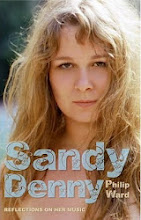
Good news! My book on Sandy Denny, first published as a paperback in 2011 and now out of print, has been reissued as an e-book. This updated edition has a new chapter "reviewing recent developments in her continuing story".
If you're yet to be converted to e-books, why not give this one a go? It's a giveaway at £4.99 or less. There are some real advantages over print. Internal cross-references, live hyperlinks in references, word-searchable text, and (only just discovered this feature myself) illustrations opening to full screen when you double-click on them. Plus, no heavy postage costs when placing orders from overseas with UK suppliers.
Publisher's webpage with links to retailers
Follow me on Facebook and Twitter
Sunday 10 March 2019


Tuesday 5 April 2016
Events in 2016

Due for release on 22 April, I've Always Kept A Unicorn is a 40-track double album of demos, live, radio and TV recordings capturing the singer-songwriter at at her most intimate in stripped-down arrangements of her repertoire. It features three previously unreleased recordings: demos recorded at Richard Branson's Manor Studios in December 1971 for the rock'n'roll covers album, Rock On. (The songs are Buddy Holly's 'Love's Made A Fool Of You' and 'Learning the Game' and, a duet with Linda Thompson, 'When Will I Be Loved' by Phil Everly.) The set is compiled by Andrew Batt and comes with sleeve notes by Mick Houghton.
This coincides with the paperback publication of Mick's biography of Sandy, also titled I've Always Kept A Unicorn.
Another book to look out for is Here She Comes Now: Women in Music Who Have Changed Our Lives, edited by Jeff Gordinier and Marc Weingarten. It's a collection of essays on artists as diverse as Dolly Parton, Nina Simone, Bjork and Taylor Swift and includes a chapter on Sandy by Rosie Schaap. First published in the US last year, the UK edition is out on 7 April.
On 27 April, as only the third recipient of such an honour, Sandy will be inducted into the BBC Radio 2 Folk Awards Hall of Fame. This will be part of an event at the Royal Albert Hall and tickets are still available from the Albert Hall box office. (The event will be broadcast live on BBC Radio 2 and will be available to watch online via live stream on the Radio 2 website. It will also be available to watch on the BBC iPlayer and the Red Button service. I believe these services are restricted to the UK.)
On to an interesting little biographical nugget... Sandy's childhood address in Wimbledon has always been given as Worple Road. But it seems the family also lived for a time round the corner in Stanton Road. How do we know? Because a secondhand copy of How To Know British Birds has turned up, inscribed, in a childish hand, "S. Denny" with an address in Stanton Road. Derrick Knight, who lived just down the road, remembers the family. Considering the significance of birds in Sandy's lyrics, I find it wonderfully apt that this childhood possession has resurfaced years later. You can read the whole story on Derrick's blog. Thanks also to Dr Neil Gibbs, now the proud owner of this little volume, for bringing his find to my attention and sending me this photo of the endpapers where the young animal-lover has doodled her favourites: horse, dog and bird. (Click on image to enlarge.)

And finally, another correspondent has kindly sent me a copy of Mainsheet, "the magazine of the Society for Sailing Barge Research". Not a journal that had come my way before, I confess, but this issue included an article about Rowland. the vessel that was home to the famous Barge folk club in the 1960s. One contributor says that "the council closed the club down as the narrow companionway was considered a fire-risk". I must say, from what I've read, it sounds as if the downstairs performing space, lit only by candles - "dusty black windows to light the dark stair", as Sandy puts it - would have been the primary risk. There are photos of the vessel later, sunk at her moorings with damaged bow, before being broken up at the Thames Conservancy Yard. There is always something poignant about a ship being "broken up". Perhaps it's because we personalise them, calling them "she" instead of "it"?
Saturday 14 February 2015


Thursday 29 August 2013
"Errors and omissions excepted"

My book on Sandy Denny was recently reprinted – an encouraging sign that interest in her work continues strong. If you’re on Facebook, may I politely ask you to “like” the book’s dedicated page? The reprint was an opportunity to fix a few typos, but otherwise the text remains the same. If there’s ever a second edition (admittedly, as Jeeves would say to an excitable Wooster, ‘the contingency is a remote one’) I’ll have the chance to correct and update then. Here, for the record...
The Australian interview footage I refer to on page 49 has now been eliminated from our inquiries. ‘Sandy Davis’ turns out to be the interviewer, not the garbled name of an interviewee, and although our Sandy is mentioned by the Fairport boys, it is only to explain her absence. The footage is now available on YouTube.
An update would also highlight the ‘Lady’ tour of last year and subsequent TV broadcast on BBC Four – Andrew Batt’s greatest coup yet in bringing Sandy’s work to the widest possible audience.
I’ve been in touch with Jean Livingstone, a Scottish singer now living in France. Under the name ‘Mona Devi’ she guested on My Kinda Folk in 1967, a series on Grampian TV hosted by Alex Campbell and Archie Fisher. Although she didn’t appear on the same show as Sandy – Jean’s fellow guests were Isla St Clair, David MacWilliams, Barbara Dickson and The Skerries – she confirmed that the programmes were recorded before transmission. This may help to unscramble the chronology of Sandy’s appearance(s) which defeated me on page 51. In the CD booklet accompanying 19 Rupert Street, Carsten Linde recalls travelling to Aberdeen for a recording of the show on 6 August 1967. This must be the edition broadcast in the Grampian region on 3 September, with guests Sandy, Johnny Silvo and Alex Sutherland. You guessed it – no copy is known to exist. Mr Linde is also emphatic that the brightly lit picture used on the cover of Sandy and Johnny (see p53n4 and the first page of colour plates in my book) was taken at the My Kinda Folk recording: there’s been some dispute about that, as the album’s August release date would make the timing extremely tight. The well-informed ‘Homage’ website opines that the cover image was taken in Birmingham during Sandy’s performance as part of ‘Folksingers for Freedom in Vietnam’ (Digbeth Civic Hall, May 1967).
The audio track of ‘White Dress’, a particularly lovely performance buried in the ITV archives for 35 years (see p52), has now been issued as a bonus track on the ‘deluxe’ reissue of Fairport’s Rising For The Moon.
The outtakes from the recording sessions for Bob Dylan’s Self Portrait album of 1970 have just appeared
in the ‘Bootleg’ series. I scanned the tracklisting with interest, recalling
that Dylan was supposed to have covered ‘Farewell, Farewell’ during those
sessions – a ‘fact’ that I carelessly quoted in the book (p110) without
checking my source. The source was Patrick Humphries’s biography of Fairport
Convention. I recently asked Patrick where he got it from and he ’fessed up
that it was a practical joke. He’d read that Pete Frame always put a deliberate
mistake in his Rock Family Trees, so he thought he’d do the same. Not a great
idea, he now admits – “it sent the Dylan fans into meltdown”. And thirty years
later, Muggins here is still falling for this jape.
I suggested (on p76) that Sandy “rewrote” ‘Gypsy Davey’ to
give it a happy ending. Versions usually end with the lady cold-shouldering her
husband as she snuggles down with her new beau, but in the Fotheringay
treatment the rejected husband finds solace with a new love “ere six months had
passed away”. My authority for this was none other than Sandy herself. Introducing
the song for a BBC radio broadcast in 1970, she said:
This is very similar to ‘The
Raggle Taggle Gypsies-O’, except that I’ve changed the words and the tune, and
I’ve made it that the story’s a bit happier at the end. I’ve allowed the other
bloke to get married, having had his wife leave him.
I had occasion to look at the Child
Ballads recently and noticed that Ballad 200J (‘The Gypsie Laddie’),
as collected in the USA in the 1840s, is very close to the wording that Sandy
uses in her version, complete with this “happy” final verse:
The great lord he rode home that
night,
He took good care of his baby,
And ere six months had passed away
He married another lady.
He took good care of his baby,
And ere six months had passed away
He married another lady.
So I fear she was rather exaggerating her part in the oral
tradition!
A reader, Steve Clarke, suggested that I had
misdescribed her school. I referred to it (more than once) as a “grammar school” (which is how she described it herself in the World Service interview). My reader advised that it was, rather, a “secondary modern”: an important distinction in those class-conscious
days. From Mick Houghton's new biography we learn that Coombe Girls' School (formerly Coombe County Secondary School for Girls) was both. Mick describes it as a "radical, bilateral school taking grammar and non-grammar streams. Sandy was in one of the grammar streams". It’s still going
strong, nowadays boasting ‘academy’ status. The author Jacqueline
Wilson attended the same school, a year or two above Sandy. I wonder if they
knew each other?
On p9 I talk about the first time Richard Thompson heard her
play ‘Who Knows Where The Time Goes’. What he told Heylin was he heard it “at
her flat on the top floor in Gloucester Road”. I identified this – probably in
error – as Stanhope Mews West. The location is more likely to be the flat she
moved to later in 1968, the one round the corner in Stanhope Gardens.
The photo on p37, taken at London Zoo in 1967, should be credited to John Harrison. Other pictures from the same shoot may be viewed here.
Typo on p57: 'Mabiniog' should, of course, read 'Mabinogion'.
No doubt there will be more updates and corrections. I’m always very happy to hear from readers.
As I reported in an earlier post, the most important update is the happy news that Shelagh McDonald (pp124-7) is now back with us – not only gigging again and making new friends but with a new album scheduled to appear in late September. During her set at the Corn Exchange, Biggar, Scotland, on 21 June this year she even slipped in a Sandy cover: ‘The Sea’. Hats off to Ms McD!
Saturday 22 June 2013
Across The Purple Sky

Bryony Holden has released a tribute album to Sandy. It was
released digitally on the 35th anniversary of Sandy’s death (21
April) and is well worth checking out on itunes.
It’s also available as a CD on demand from Amazon
US (but not UK).
Bryony writes:
“Across The Purple Sky
was a labour of love, a joy of a project. For as long as I can remember, people
have made comparisons between my voice and Sandy’s and although they are not
the same, there are similarities. I grew up in the 1960s, and Sandy was, of
course, one of the hub of influences from those paisley patterned, patchouli-scented
times. I'd remained determined NOT to make a tribute for so many years but
eventually gave up resisting the many requests as it seemed the time was
finally right. My sister, Erin, was more than up for the task and not only lent
her fine instrumental skills, but produced, mixed and mastered the project.
Trying to touch on so many aspects of Sandy's work, we chose the tracks to span
as much as possible in a short space, covering some of her work with
Fotheringay and with Fairport. It was almost impossible to choose and we
recorded more than the ten on the album. At some point, it is likely to be
produced as a full CD… and those extra tracks will be added. What an amazing
performer… what an amazing woman. Sandy Denny, much loved and respected muse…
thank you.”
In other news, Dave Swarbrick has given an interview
to folk blogger Emma Hartley. He talks about Sandy, among other topics, reminding us how difficult
it was for him to do the tribute shows in 2008 and 2012: “You’ve got to understand,
I have never got over her dying.”
There was also an event at Banbury Folk Club on 19 June, “Linda Watkins and Friends Sing Sandy”, which sounded interesting for anyone in the Oxfordshire area.
There was also an event at Banbury Folk Club on 19 June, “Linda Watkins and Friends Sing Sandy”, which sounded interesting for anyone in the Oxfordshire area.
Monday 11 February 2013
The return of Shelagh McDonald

Shelagh McDonald, 2012. Photo: Ian Anderson. From fRoots 353/354,
November/December 2012
If there’s one chapter of my Sandy Denny book in serious need of update it’s the short short one on Shelagh McDonald. As I write there, Shelagh had the world at her feet in the early Seventies. A talented singer, songwriter and guitarist, a woman of striking beauty with two acclaimed albums to her name, she was hailed by Melody Maker as a worthy ‘successor to Sandy Denny’. Then she simply vanished. For over thirty years no one knew where she was or even if she was still alive. A brief reappearance in 2005 brought news of the reasons for her disappearance and a reassurance that she was happy and well, but then we heard no more. Until 2012, that is. Early last year her husband died, and out of the sad circumstances of his passing was born a desire to pick up her music again, to reconnect with her old friends and dip her toe in the waters of a much-changed music scene. The story is well told in Ian Anderson’s lengthy feature in fRoots magazine, available online, so I won’t rehearse it here. Since then she has made several low-key appearances in Scotland, and in January this year was lured down to London to make her first appearance in the capital for over forty years in a support slot to Anderson’s new duo, The False Beards. It was a top-notch night. A clip on YouTube (’Let No Man Steal Your Thyme’) shows how, despite evident nerves, her musicianship and charm have not diminished with the years.
In the fRoots
interview, Shelagh talks a little about Sandy, whom she knew, pointing to a
conflict between Sandy’s gregarious nature and the isolation she needed for her
songwriting: ‘There was this wealth of songs in her, but she couldn’t organise
her time – I felt that a lot of her friends should have respected that and
given her more space.’
If everything comes to fruition, the future for Shelagh is
bright: more live gigs (including one with The
Razorbills), a reissue of her two albums from the Seventies (currently
out of print again), possibly even recording of the many new songs she has been
writing. There’s a Facebook
group devoted to her, which may be the best source of information
until she has a website up and running.* I only managed to snatch a few words
with her at the London event but hope to interview her at some point for a
magazine piece.** As for what I wrote about her in the book, well, I slightly
regret making a direct comparison between Sandy and Shelagh. In my defence, I
can only say that, at the time of writing, I never expected to see Shelagh
perform, much less meet her. In the ‘remote contingency’ of a second edition, I
shall have to eat my words, or at least chew them more slowly.
_________
*Postscript, 25.3.13: there is now an excellent Shelagh McDonald website where fans can keep track of her activities and promoters can get in touch with her. And another delightful clip has appeared on YouTube, this time from A' the Airts, Sanquhar: ’Rigs O' Rye’._________
** This interview, conducted in July 2013, is now online at my other blog.
Sunday 21 October 2012
Daylilies

Lambertson '98
[Druid's Chant x Sea Urchin] 5.5" Semi. Ev. Re. Em. 27" Tet. A
beautiful blue lavender with a white star burst coming out of a green throat
and gold edging. Great parent, producing sharks tooth edging.
“Sandy Denny” is a variety of daylily (hemerocallis) hybridized by Ludlow Lambertson in 1998. Luddy and
his wife Rachel describe themselves as “huge fans of both Sandy and Fairport
Convention”, hence the choice of name. Rachel sings; Ludlow is the hybridizer;
both are painters. Based at Lake Helen, Florida, they open their garden to the public
during daylily bloom season, which runs from May to June (details on their
website at Art Gallery Gardens). What you won’t find on display, alas, is the “Sandy
Denny” bloom. They no longer have it. And nor does anyone else, as far as I can
establish. A website in Canada, Rural Roots Gardens, purports to offer it for
sale, but the illustration is incorrect (it shows another of Lambertson’s
hybrids, “Do The Twist”) and my enquiries have gone unanswered.
Some years ago a horticulturalist in south London contacted
me, saying she was planning to import “Sandy Denny”. I met her when she came to
the Troubadour tribute in 2008, but
Kyle Orosz, who designed the authoritative Sandy website at www.sandydenny.org.uk,
incorporated the flower into his illustrations.
Do we know any more about this elusive bloom?
Thursday 4 October 2012
Calling New Yorkers!

Friday 12 October, 7pm
Salina Sias
“The Songs of Sandy Denny”
Rockwood Music Hall
196 Allen Street
New York, NY 10002
Salina is a New York-based singer-songwriter who has become a great Sandy enthusiast, keen to spread the word. She writes:
‘…I discovered her work thanks to Robin Millar, also known as “The man behind Sade” and one of the UK’s most successful record/music producers. He was kind enough to lend an ear and give me advice – he was the one who introduced me to the names Sandy Denny and John Martyn. He thought, perhaps, my original music was influenced by their work. I love being influenced by someone I did not know – a kind of karmic ethos.’
Interesting lady – a daughter-in-law of Norman Mailer, no less. If you’re a fellow fan in the NYC area, I’m sure she’d be delighted to see you at her gig.
Sunday 12 August 2012
The Notes and the Words

The Notes And The
Words: A Collection Of Demos And Rarities
From the Sandy Denny official website:
Due to the phenomenal and totally
unprecedented demand for Island’s complete Sandy Denny Box Set,
released in November 2010, Universal Music is issuing a limited edition 4 CD
version.
This boxset will be released on the
29th of October, and is available for pre-order now on Amazon UK.
The original box set has become
one of the most collectible box sets of all time. Now, for fans that missed
out, this new four disc set boasts 75 songs that represent the cream of the
rarities, demos and outtakes from the box set, including 17 demos taken from
the master tapes of Sandy’s early home recordings. Among these is the first
known recording of 'Who Knows Where The Time Goes', recorded in 1967. The set
also features demos, outtakes and alternate versions of Fairport and
Fotheringay classics as well as many tracks from her solo career.
Having now seen the complete track listing, I can supply more
details:
- There’s nothing on here that wasn’t on the big box.
- The majority of tracks appeared for the first time on the big box.
- A handful of tracks on here appeared first on the big box, then again as bonus tracks on the “deluxe” reissues of the solo albums.
- There’s a small overlap with Boxful Of Treasures and the Who Knows Where The Time Goes boxset.
- There are a (very) few tracks that have appeared before on single albums (e.g. Fotheringay 2, Alex Campbell & His Friends).
- The packaging is more sensible this time – you don’t need to build an extension to your house to accommodate this one.
Other news:
- The provisional date for the TV broadcast of 'The Lady', the Barbican tribute concert, is now 9 November (BBC4). (There is also a one-hour documentary on Fairport Convention scheduled for 14 September on the same channel.)
- As its coverage of the London Olympics draws to a close, BBC TV has repeatedly (and quite rightly!) been showing a montage of British medal winners to the accompaniment of Thea Gilmore singing ‘London’ – which might just spark further interest in Thea’s Sandy project. Seems like everyone’s a winner from the Olympics. (If the BBC link doesn't work for you, the montage is also available on YouTube.)
- The latest issue of Clifton Life (pp56-9) has an affectionate piece by Ian A Anderson looking back to the heyday of the Bristol Troubadour club in the 1960s. He recalls the famous names who graced its tiny stage, Sandy among them. It also includes a photo of the reclusive Shelagh McDonald, taken on her visit to Bristol earlier this year.
- Currently on eBay is a rare chance to acquire a Sandy autograph. This framed piece of sheet music of 'Tarantelle in A-flat for piano by Stephen Heller' measures 25x30cm and belonged to Sandy. It was given by her to Dave Swarbrick, who is now auctioning this item for charity. The item is authenticated by Dave Swarbrick in a signed declaration on the back of the frame.The proceeds of this auction will be donated to Ethiopiad, who have been working in Ethiopia since the late 80s and are a charity committed to using their funds to create self-sufficiency.
Monday 28 May 2012
The Lady at the Barbican

As readers of my book will know, 2008 saw a notable tribute concert at London’s Queen Elizabeth Hall. In the words of the organiser, ‘it was designed to avoid the mawkish and place the focus firmly on Sandy’s songwriting’. A little over three years on, that concept has taken wing in the form of an eight-stop tour of English cities. Playing to sold-out houses and earning standing ovations, it landed in London last week, where I was lucky enough to see it.
The Barbican concert wasn’t about egos; it wasn’t a ‘talent’ show, with tear-stained contestants and acid-tongued judges. Nor was it an exercise in biography with musical illustrations. (I didn’t catch Patrick Humphries’ pre-concert talk, but I’m sure he provided all the context a newcomer would need.) No, this was a celebration, by a variety of artists from different generations and different backgrounds, of Sandy’s musical legacy.
Twenty-five songs. What a feast!
Maddy Prior had never sung Sandy’s own compositions before, but you wouldn't guess it as she ranged easily from the madrigal inflections of ‘Fotheringay’ to the angry dissonance of ‘John The Gun’. Unlike the thunderous majority, I don’t share in the general rapture over Thea Gilmore’s completion of Sandy’s unfinished songs. I find the whole project slightly dubious. However, Thea is a powerful stage presence, and there’s no denying her uptempo contributions (‘London’, ‘Don’t Stop Singing’) varied the mood. Lavinia Blackwall of Trembling Bells was perfectly cast for the folkier end of Sandy’s output. Her ‘Quiet Joys Of Brotherhood’, which she’d arranged in three-part harmony with Prior and Gilmore to back her, was one of the most beautiful things I’ve heard in ages.

For me, the two American contributors, both from way outside the English folk-rock axis, were the revelation of the night. As she left behind her folk roots on the later solo albums, Sandy was edging towards a more ‘accessible’ style, and arguably a more ‘American’ style. This is what American singers bring out when they cover her songs. Joan Wasser (aka Joan As Policewoman) delivered two superb numbers at the piano. Palpably savouring the rich chordal progression of ‘The Lady’, Wasser hinted at the song’s jazz potential, and I found myself thinking of another great artist called too soon to the studio in the sky – Laura Nyro. Meanwhile, PP Arnold, looking extraordinarily young for her 65 years, comes from yet another tradition. With heavy vocal backing in the chorus, ‘Take Me Away’ became the epic soul number we never realised it was. Indeed, PP likes the song so much she has recorded it; a download is available from her website.

So this night belonged to The Lady and it belonged to the ladies. I have to say the male singers left me underwhelmed. I recall Green Gartside from the Nick Drake tribute a couple of years ago, but he made no stronger impression here than he did there. While Blair Dunlop (son of Fairport founder Ashley Hutchings) is a talent to watch and Sam Carter was sharp and to-the-point, soloing on ‘Bushes And Briars’ and duetting playfully with Swarb on ‘It Suits Me Well’, I missed two of the more distinctive talents that had adorned the QEH show in 2008: Johnny Flynn and Marc Almond. Both had prior commitments, alas.
As encore, we finished inevitably on ’Who Knows Where The Time Goes?’ tutti. One dyspeptic reviewer in a national newspaper took exception to the ensemble turning this quietly contemplative ballad into a soft-rock anthem for massed forces. I (sort of) know what he means – it received similar treatment in the ‘Daughters Of Albion’ concert at the same venue in 2006. But it’s the song everyone in the audience expects to hear and everyone on stage wants to sing, so the format is almost pre-ordained.
Members of Bellowhead provided a strong house band throughout, augmented by Fairport veterans Jerry Donahue on electric guitar and the irrepressible Dave Swarbrick on violin.
The BBC were filming the show for television (transmission at a later date, as yet unknown), which seemed to give extra edge to the performances. It certainly added to the nerves, causing even artists as experienced as Maddy Prior and Pat Arnold to suffer false starts.
The gig, and the tour of which it formed part, were a massive team effort and team success. But we should single out for mention producer and compere Andrew Batt. Andrew has done more than most in the last five years to bring Sandy’s work to a wider public and to ensure that it has a future. As well as producing the 2008 tribute show which formed the template for this tour, he researched and compiled the massive 19-CD box of her Collected Works and the recent ‘deluxe’ reissues of the solo albums. I doubt that anyone outside the ‘business’ understands just how much work is involved here, especially in putting together a multi-artist, multi-venue tour like this one. So hats off to Mr B!
And then, still hatless, let’s raise a glass to Ms Denny, without whom none of this would be happening.
Set list
A Sailor's Life - Lavinia Blackwall
Late November - Lavinia Blackwall
North Star Grassman And The Ravens - Green Gartside
Stranger To Himself - Green Gartside
Glistening Bay - Thea Gilmore
London - Thea Gilmore
Bushes And Briars - Sam Carter
Fotheringay - Maddy Prior
John The Gun - Maddy Prior
The Sea - Blair Dunlop
It’ll Take A Long Time - Blair Dunlop
By The Time It Gets Dark - Joan Wasser
The Lady - Joan Wasser
INTERVAL
Matty Groves - Ben Nicholls
Long Time Gone - Thea Gilmore
Don’t Stop Singing - Thea Gilmore
Quiet Joys Of Brotherhood - Lavinia Blackwall
It Suits Me Well - Sam Carter & Dave Swarbrick
Nothing More – Green Gartside
Solo - Maddy Prior
I’m A Dreamer - PP Arnold
Like An Old Fashioned Waltz - PP Arnold
Take Me Away - PP Arnold
ENCORES
Late November - Lavinia Blackwall
North Star Grassman And The Ravens - Green Gartside
Stranger To Himself - Green Gartside
Glistening Bay - Thea Gilmore
London - Thea Gilmore
Bushes And Briars - Sam Carter
Fotheringay - Maddy Prior
John The Gun - Maddy Prior
The Sea - Blair Dunlop
It’ll Take A Long Time - Blair Dunlop
By The Time It Gets Dark - Joan Wasser
The Lady - Joan Wasser
INTERVAL
Matty Groves - Ben Nicholls
Long Time Gone - Thea Gilmore
Don’t Stop Singing - Thea Gilmore
Quiet Joys Of Brotherhood - Lavinia Blackwall
It Suits Me Well - Sam Carter & Dave Swarbrick
Nothing More – Green Gartside
Solo - Maddy Prior
I’m A Dreamer - PP Arnold
Like An Old Fashioned Waltz - PP Arnold
Take Me Away - PP Arnold
ENCORES
No More Sad Refrains - Joan Wasser
Who Knows Where The Time Goes? - ensemble
The band
Pete Flood..................Musical director/drums/percussion
Jerry Donahue...............electric guitar
Benji Kirkpatrick...........mandolin/acoustic guitar
Nigel Stonier...............acoustic guitar
Andy Mellon.................piano/trumpet
Nick Pynn...................violin/viola
Ben Nicholls................bass
Sam Carter..................acoustic guitar
Who Knows Where The Time Goes? - ensemble
The band
Pete Flood..................Musical director/drums/percussion
Jerry Donahue...............electric guitar
Benji Kirkpatrick...........mandolin/acoustic guitar
Nigel Stonier...............acoustic guitar
Andy Mellon.................piano/trumpet
Nick Pynn...................violin/viola
Ben Nicholls................bass
Sam Carter..................acoustic guitar
Subscribe to:
Posts (Atom)